
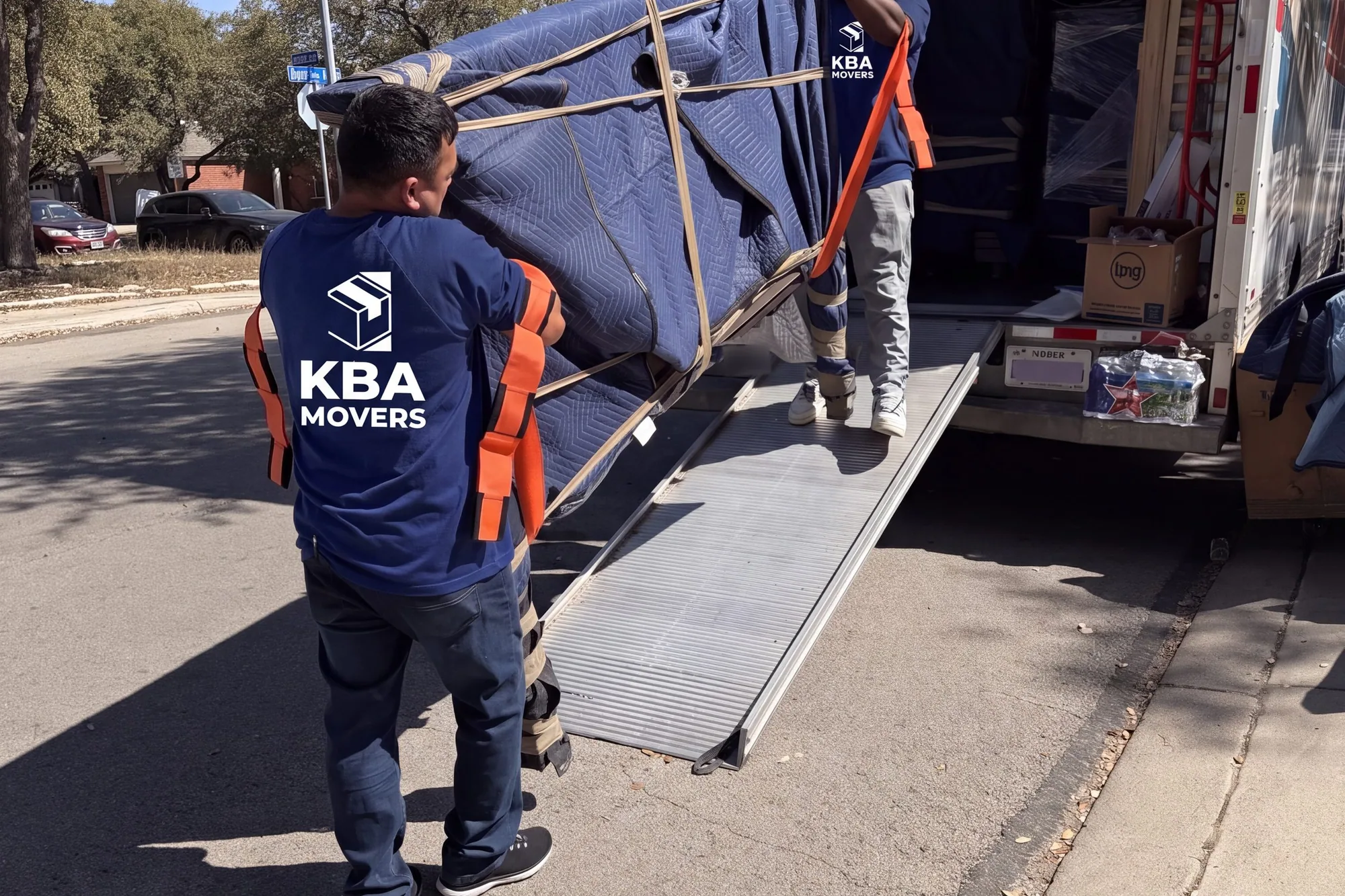
How long does a local move take?
Local moves in the metro are billed for crew time, which makes hours the number that actually decides what you pay. The cost guide covers what changes the price. This one covers what changes the clock.
Nobody can give you a figure for your house without seeing it, and any answer here in hours would be invented. What can be described is the shape of the day and which parts of it are elastic, which is the more useful thing anyway.
The day has four parts and only two of them are about your stuff
A local move runs as travel to you, load, travel to the new address, unload. Loading is almost always the longest of the four and unloading is usually meaningfully faster, because at the origin the crew is solving a puzzle and at the destination they are following a plan.
The travel legs are the ones people forget when they compare quotes. Whether the trip from the yard to your door is billed differs between companies, and on a cross-metro move that leg is not trivial.
What actually stretches the loading half
The number of bedrooms is a weak predictor. Two houses with identical floor plans can be hours apart, and the difference is almost always one of these five things.
- Whether the packing is finished. Sealed and labeled boxes load at a completely different speed to open ones, and half-packed is the slowest state of all
- Stairs, particularly a stairwell with a turn on the landing
- Carry distance, which is how far a loaded truck can get from the door
- Disassembly, usually beds, wall units and anything mounted
- Density. A four-bedroom with sparse furniture can load faster than a packed two-bedroom
The parts you control
Three things reliably shorten a move day and all of them happen before the crew arrives. Finish the packing, including the garage and the shed nobody wants to think about. Clear the routes so nothing has to be moved before something else can be moved. And park your own cars somewhere else so the truck gets the closest legal spot.
The fourth is the walkthrough. Five minutes at the start showing the crew what is going, what is staying and what is fragile saves more time than it costs, because every item a mover has to ask about is a pause.
What blows a day out entirely
The overruns that matter are rarely gradual. They are usually one of a handful of specific events: a lift in a managed building that turns out to need booking, a certificate of insurance the building wanted and nobody requested, a closing that has not funded so the keys are not available, or a single item that will not go through a door and has to be dismantled.
All four are avoidable a week out and none of them are avoidable on the morning. If any of them could apply to your move, that is the conversation to have when you book.
Getting a realistic estimate of hours
Ask for the estimate in crew and hours rather than just a total, because that is the thing you can sanity-check. Give both addresses so the access at the origin is part of the calculation rather than an assumption.
Then describe the hard part honestly. The sofa that fought its way into the basement, the elevator that has to be booked, the fact that you are still deciding about the garage. An estimate built on the real picture is one you can plan a day around.